Inventory Over Influence: British Retailers Confront the Harsh Arithmetic of Creator Commerce
As social platforms push native checkouts and livestreaming onto the high street, domestic chains are discovering that creator-led sales carry an unforgiving logistics bill.

Inside a distribution facility near Milton Keynes, warehouse operatives are processing a conveyor of apparel returns generated from an evening of creator-led social broadcasts. For two decades, British multi-brand stalwarts such as ASOS and Next fine-tuned domestic fulfilment to handle predictable seasonal cycles. Creator commerce, however, introduces a chaotic rhythm: sharp spikes in short-term order volume followed immediately by an equally aggressive wave of domestic parcel returns. While digital platforms promote livestreaming and in-app storefronts as the natural successor to traditional e-commerce, Britain's established retailers are viewing the format through the cold discipline of net operating margins.
The United Kingdom remains Western Europe’s most digitally penetrated retail market, with online transactions consistently representing more than a quarter of all consumer spending. Yet the transition from traditional affiliate marketing to closed-loop creator commerce has disrupted a fragile equilibrium. Where consumers once followed external tracking links directly to the e-commerce websites of Marks & Spencer or John Lewis, social platforms now demand that browsing, payment, and customer engagement occur entirely within their proprietary applications. For domestic retailers operating on razor-thin operating margins, that structural shift demands significant concessions on transaction fees and customer data ownership.
A Margin Squeeze in the Delivery Bay
The primary operational hazard lies in reverse logistics. Across British apparel retail, return rates for womenswear have long hovered between twenty-five and thirty-five per cent. Purchases prompted by impulsive algorithmic feeds, rather than deliberate catalog searches, tend to exceed that baseline significantly. When a garment selling for £32 generates five pounds in combined courier charges and warehouse re-bagging costs, the commercial logic of paying a creator commission between eight and twelve per cent rapidly evaporates. For pure-play merchants struggling to restore profitability after several years of supply-chain inflation, creator-fuelled volume can easily turn cash-flow negative upon arrival at the depot.
Grocery and quick-commerce operators have adopted a markedly more defensive posture. Rather than surrendering checkout mechanics to social video feeds, grocers including Ocado and Sainsbury’s have favoured curated recipe integration, where food creators assemble shoppable baskets that direct the shopper back to proprietary digital infrastructure. Deliveroo and Just Eat have followed an analogous blueprint, using regional creators to spotlight virtual restaurant concepts while retaining sole custody of driver dispatch, delivery surcharges, and diner contact records. In both instances, the creator serves as a customer-acquisition funnel rather than an independent storefront.
Defending Customer Custody
This split points to the fundamental tension governing creator commerce across the British market: the preservation of first-party consumer relationships. For Marks & Spencer, whose recent resurgence has relied upon expanding its active loyalty base and driving cross-category shopping between clothing and food halls, relinquishing the customer relationship to a third-party social feed represents an existential risk. In response, the group has leaned heavily into internal colleague advocates, cultivating storefront ambassadors directly from its own store teams to keep digital footfall anchored to the retailer’s own mobile application.
Retail finance directors are no longer seduced by vanity metrics such as live-stream impressions or casual engagement tallies. With domestic household budgets remaining disciplined under sustained cost-of-living constraints, experimental retail channels are being audited strictly on net contribution margin. Creator commerce will undoubtedly secure a permanent allocation within the marketing mix, but its expansion across the United Kingdom will be dictated not by platform hype, but by which operators can successfully integrate social influence into the unglamorous mechanics of British parcel delivery and domestic returns.
News Legacy maintains editorial independence. Some recommendations may contain affiliate links. We earn from qualifying purchases at no additional cost to you. Read our policy.
Read Next

Is Sohna Really the Next Chhatarpur?
Three decades after Chhatarpur redrew South Delhi's map for space, privacy and exclusivity, a familiar pattern is now taking shape further south, and Sohna is where the smart money is beginning to look.
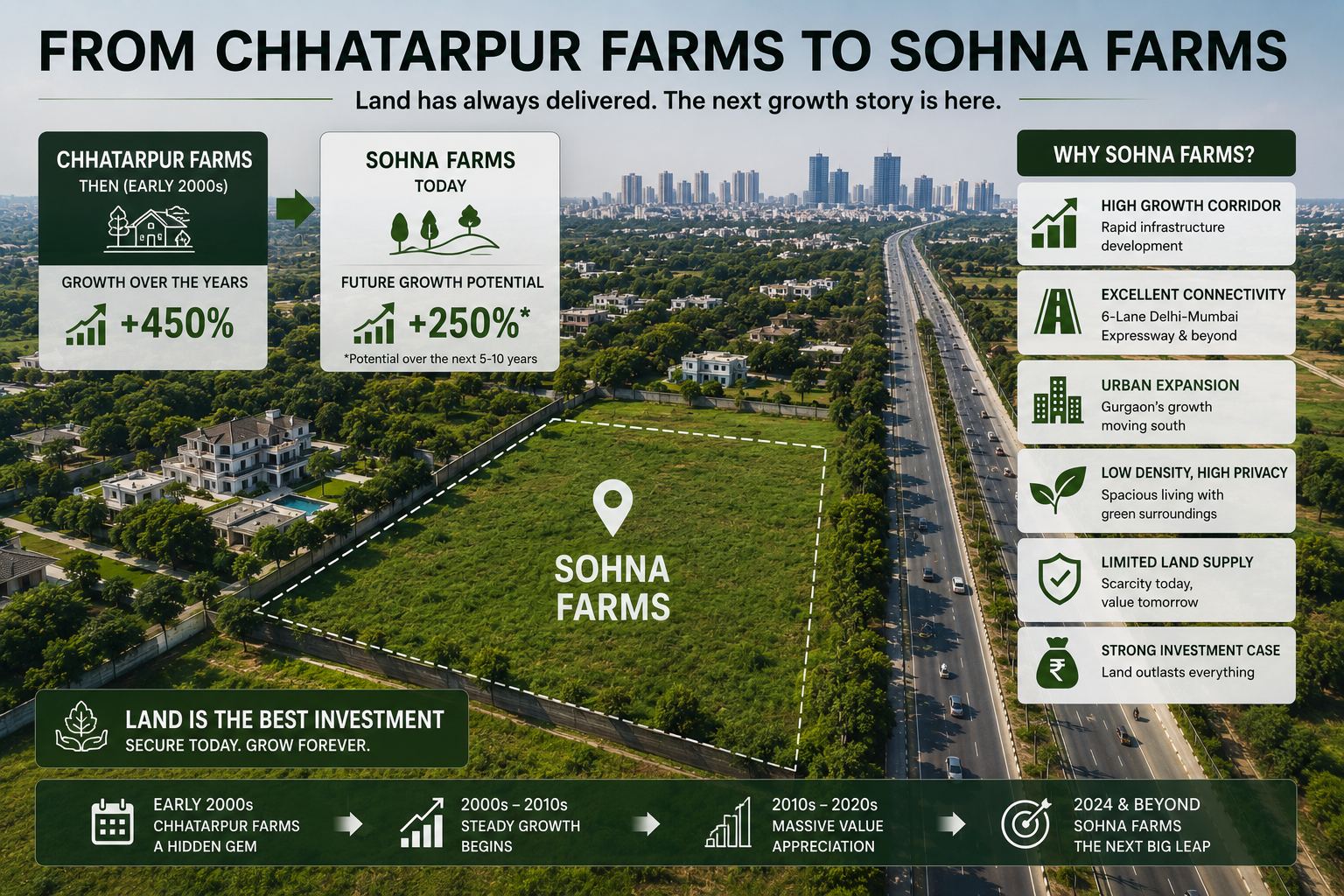
How Chhatarpur Farmhouses Created Multi-Crore Wealth for Early Buyers
What a quiet corner of South Delhi can teach investors about land, scarcity, and long-term wealth creation.

The ₹5 Crore Land Purchase That Became Worth ₹70 Crore
What the Story of DLF Chhatarpur Farms Reveals About Wealth Creation Through Premium Land Ownership
One short email. Stories you can use.
A free, occasional email from our editorial team with our latest features, explainers and reads. Unsubscribe any time — your email stays with us.