Ocado's Existential Juggling Act: Balancing Growth Against Market Scepticism
The online grocer faces sustained pressure to demonstrate scalable profitability amidst an evolving retail landscape and cautious investor sentiment, particularly as the novelty of pandemic-driven digital adoption wanes.

At a recent investor briefing, Ocado’s executives presented a complex picture of technological advancement juxtaposed against persistent financial challenges. While the firm's advanced robotics and fulfilment systems continue to impress as engineering marvels, questions linger about the pace of their global deployment and, crucially, their return on investment. The company's share price volatility over the past year reflects a broader market scepticism regarding its path to consistent profitability, even as its retail division maintains a solid, if unspectacular, performance in the UK.
The initial surge in online grocery adoption during the pandemic offered Ocado a significant tailwind, validating its long-held vision of automated e-commerce. However, as consumer habits normalise and the cost-of-living crisis bites, the growth trajectory for purely online propositions has softened. Rivals like Tesco and Sainsbury's, leveraging their extensive physical store networks for click-and-collect or local delivery hubs, have demonstrated a hybrid model that can be more capital-efficient in certain urban and suburban geographies. This operational flexibility poses a challenge to Ocado's high-capex, centralised warehouse approach.
The Technology Dividend Under Scrutiny
Ocado's primary value proposition lies in its Ocado Smart Platform (OSP), an end-to-end solution for online grocery operations. The company has secured partnerships with major international retailers such as Kroger in the US and Groupe Casino in France. Each new Customer Fulfilment Centre (CFC) represents a significant investment in robotics, software, and infrastructure, promising unparalleled efficiency and accuracy once operational. Yet, the build-out and ramp-up phases are protracted and expensive, leading to a long lead time before these investments contribute meaningfully to group profitability. The market is increasingly demanding tangible evidence of these technological advantages translating into consistent earnings.
In the UK, the joint venture with Marks & Spencer, Ocado Retail, navigated a challenging year marked by rising energy costs and supply chain disruptions. While its customer base remains loyal, competition from the aforementioned supermarket giants, alongside rapid delivery services like Deliveroo and Just Eat expanding into quick commerce, intensifies. These quick commerce players, though not directly competing on a full weekly shop, fragment consumer spend and introduce new expectations around speed and convenience, pushing traditional online grocers to innovate further.
The challenge for high-tech logistics providers is to move beyond proof of concept and deliver consistent, measurable financial returns that justify the substantial upfront capital expenditure.
Shifting Consumer Habits and Market Dynamics
The British consumer's relationship with online grocery has matured since the initial pandemic-induced acceleration. While a significant portion of shoppers continues to value the convenience of digital ordering, price sensitivity has become paramount. Promotions and loyalty schemes offered by incumbent supermarkets often sway purchasing decisions, an area where Ocado Retail, despite its premium positioning, must remain competitive. Furthermore, the environmental impact of extensive delivery networks is under increasing scrutiny, adding another layer of complexity to operational decisions.
Ocado's long-term success hinges on its ability to scale its OSP technology globally and efficiently, turning its impressive engineering prowess into a highly profitable enterprise. The company's strategic vision is clear: to be the technology backbone for the world's leading grocers. However, the market's patience for substantial capital deployment without corresponding short-to-medium-term returns is finite. The upcoming financial reports will be closely scrutinised for signs of accelerating CFC rollouts, improved operational leverage, and a clearer pathway to sustained group-level profitability that can assuage investor concerns and stabilise its valuation.
The landscape for online retail in the UK, as exemplified by the varying fortunes of pure-play online fashion retailers like ASOS and established omnichannel players like Next, demonstrates the enduring value of integrated strategies. For Ocado, the balancing act involves proving that its pure-play technology model can not only compete but decisively outperform hybrid alternatives in a cost-conscious and increasingly discerning market.
News Legacy maintains editorial independence. Some recommendations may contain affiliate links. We earn from qualifying purchases at no additional cost to you. Read our policy.
Read Next

Is Sohna Really the Next Chhatarpur?
Three decades after Chhatarpur redrew South Delhi's map for space, privacy and exclusivity, a familiar pattern is now taking shape further south, and Sohna is where the smart money is beginning to look.
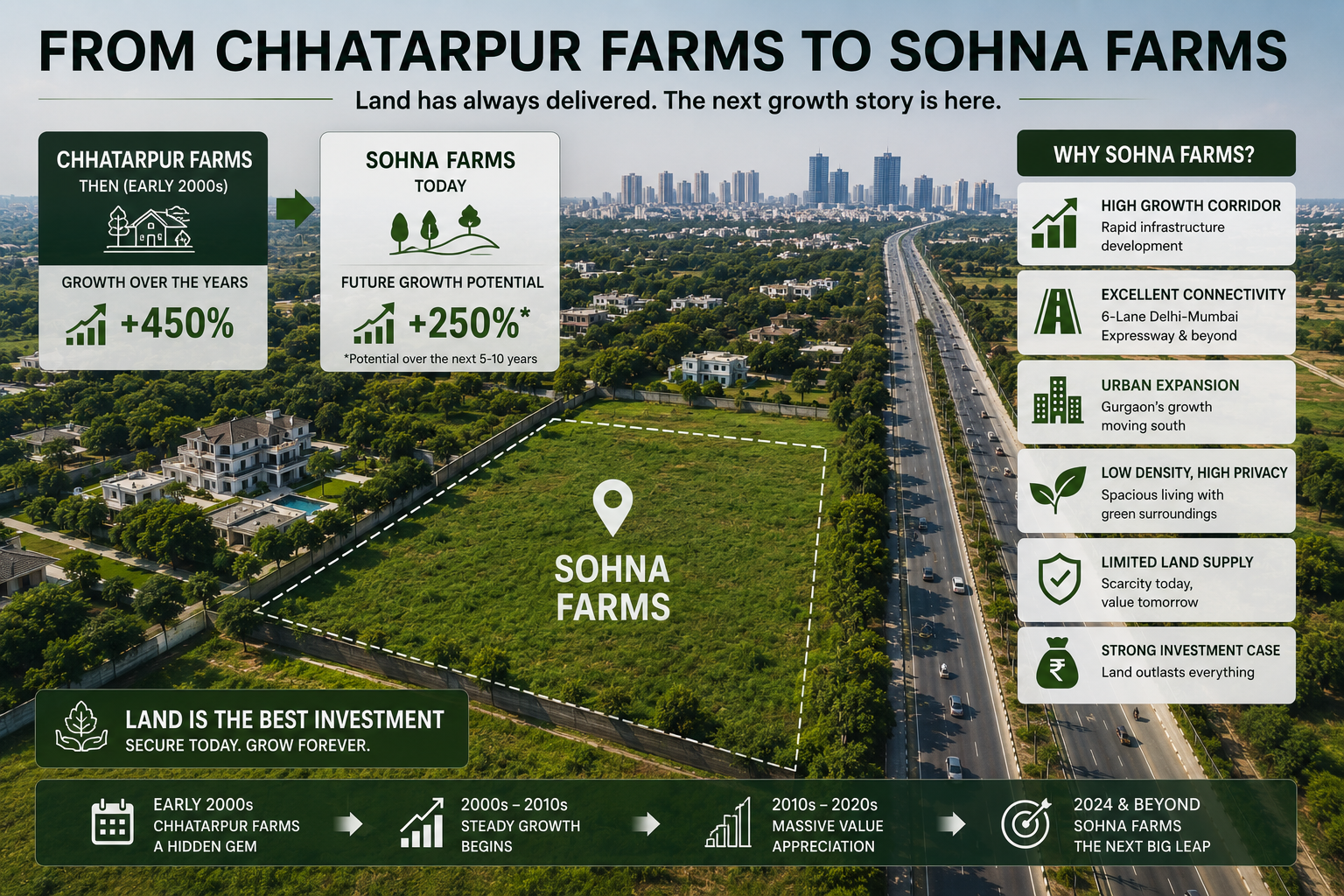
How Chhatarpur Farmhouses Created Multi-Crore Wealth for Early Buyers
What a quiet corner of South Delhi can teach investors about land, scarcity, and long-term wealth creation.

The ₹5 Crore Land Purchase That Became Worth ₹70 Crore
What the Story of DLF Chhatarpur Farms Reveals About Wealth Creation Through Premium Land Ownership
One short email. Stories you can use.
A free, occasional email from our editorial team with our latest features, explainers and reads. Unsubscribe any time — your email stays with us.