The Micro-Fulfilment Divide: How Britain’s Supermarkets Are Sidestepping the Automation Trap
As borrowing costs persist and volume growth moderates, the UK's grocery sector is abandoning monolithic robotic sheds in favour of store-floor picking and quick-dispatch couriers.

Inside Ocado's automated customer fulfilment centres in Erith and Purfleet, thousands of proprietary bots swarm mechanical grids with millimetric discipline. Yet across suburban Britain, the real battle for delivery supremacy is being waged not by multi-million-pound gantry systems, but by supermarket workers in high-visibility vests wheeling double-decker plastic totes down regular supermarket aisles. Rather than sinking capital into bespoke outer-London logistics fortresses, Tesco and Sainsbury's have turned thousands of existing high-street and out-of-town branches into micro-fulfilment hubs, deploying gig-economy couriers from Deliveroo and Just Eat to handle immediate dispatch.
The tactical divergence underscores a stark reckoning across British logistics. When central bank interest rates were anchored near zero, the long payback horizon of multi-temperature automated warehouses was an easily defended balance-sheet luxury. Today, with capital hurdles substantially higher and domestic grocery volumes growing only modestly, the arithmetic governing pure-play automated fulfilment looks increasingly unyielding.
The capital friction of algorithmic perfection
Ocado's capital-intensive strategy was predicated on continuous, compounding throughput: massive fixed costs offset by unmatched operational efficiency and vanishingly low pick-error rates. However, establishing a modern customer fulfilment hub in Britain regularly requires north of £40m in upfront capital expenditure before accounting for bespoke software, continuous hardware maintenance, and rising regional industrial ground rents. For regional coverage outside the lucrative home counties, that capital payload becomes acutely difficult to amortise.
Tesco and Sainsbury's, by contrast, carry almost negligible capital overhead when converting back-of-store holding zones into staging areas for on-demand orders. Tesco's Whoosh service, which promises deliveries within sixty minutes from hundreds of local express stores, effectively treats the shelf inventory already funded by retail footfall as its staging depot. The marginal cost of picking an order by hand remains higher per unit than using a robotic gantry, but the upfront capital commitment is practically zero.
For all the architectural elegance of automated hive grids, an existing suburban supermarket and a fleet of contracted couriers remain far cheaper to amortise.
The suburban parcel conduit
This retreat from dedicated fulfilment monoliths is reshaping apparel and parcel logistics as well. Pure-play online retailers such as ASOS have spent the past eighteen months rationalising inventory facilities and reining in free returns after soaring transport fees undermined unit economics. Traditional hybrid operators, led by Next and Marks & Spencer, have instead converted their physical store portfolios into dense collection and return networks.
Next has leveraged this physical proximity to remarkable effect through its Total Platform division, integrating third-party fashion logistics into its own distribution spine. Over half of Next's online orders are collected from or returned to physical branches, bypassing expensive domestic courier networks entirely and converting an administrative overhead into footfall for store-floor sales. Marks & Spencer has followed suit, leveraging its food halls and suburban clothing shops to process digital volumes without having to build duplicate regional distribution centers.
British consumer behaviour has decisively accelerated this hybrid pivot. Squeezed by mortgage refinancing and higher energy outlays, households are eschewing the large, predictable weekly shop that once made £100 delivery baskets so profitable for dedicated distribution grids. Shoppers are purchasing smaller quantities more frequently, often relying on rapid-delivery aggregators to plug short-term pantry gaps or walking to suburban click-and-collect counters to evade courier surcharges.
Automation has not been wholly abandoned, but its geographic mandate has contracted. The conviction that monolithic out-of-town distribution grids would inevitably render suburban storefronts obsolete has collided with structural cost pressures. In the immediate future of British logistics, proximity and store density are proving far more adaptable than mechanical perfection.
News Legacy maintains editorial independence. Some recommendations may contain affiliate links. We earn from qualifying purchases at no additional cost to you. Read our policy.
Read Next

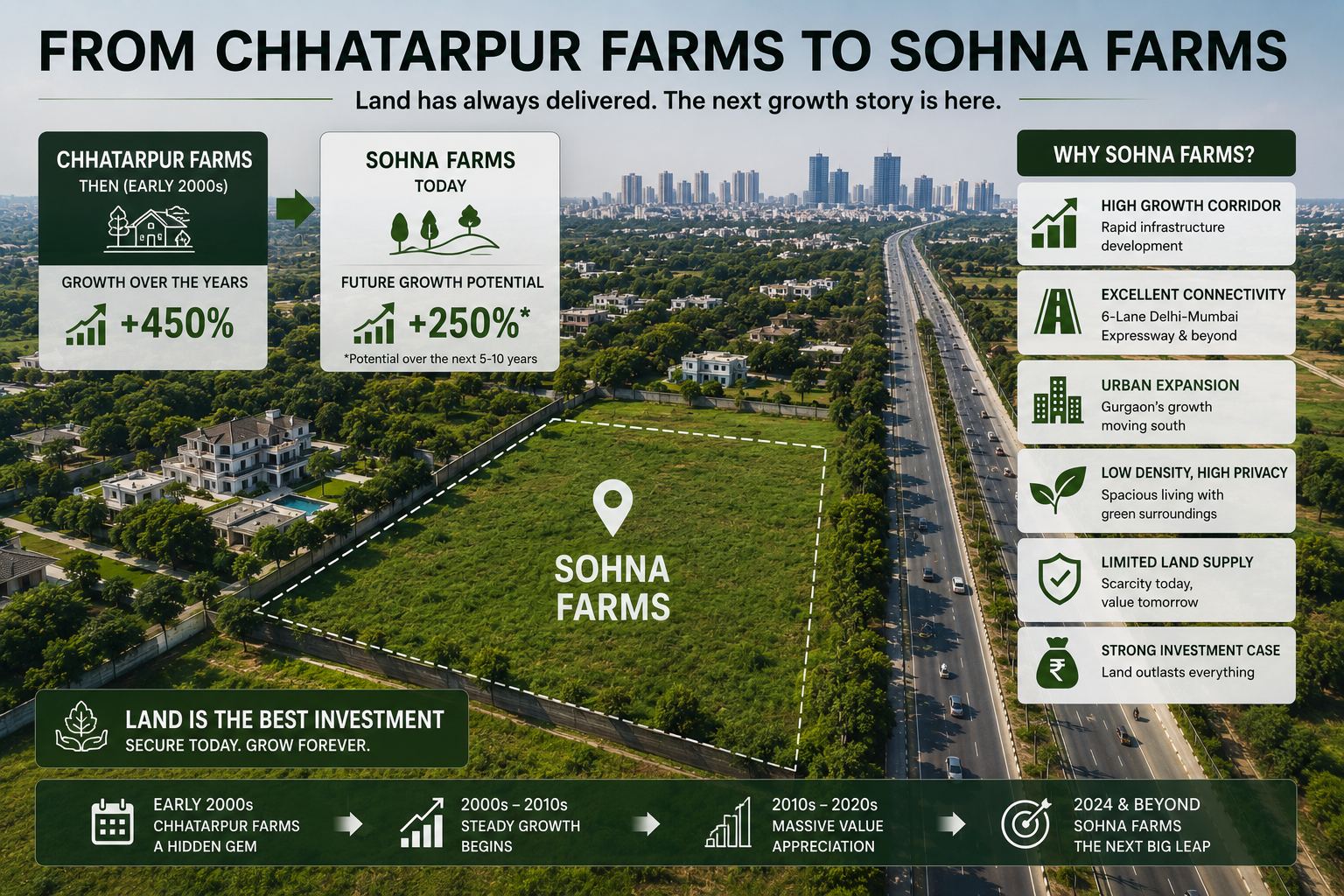
Is Sohna Really the Next Chhatarpur?
Three decades after Chhatarpur redrew South Delhi's map for space, privacy and exclusivity, a familiar pattern is now taking shape further south, and Sohna is where the smart money is beginning to look.
How Chhatarpur Farmhouses Created Multi-Crore Wealth for Early Buyers
What a quiet corner of South Delhi can teach investors about land, scarcity, and long-term wealth creation.

The ₹5 Crore Land Purchase That Became Worth ₹70 Crore
What the Story of DLF Chhatarpur Farms Reveals About Wealth Creation Through Premium Land Ownership
One short email. Stories you can use.
A free, occasional email from our editorial team with our latest features, explainers and reads. Unsubscribe any time — your email stays with us.