The Partitioned Pantry: National Bastions and Thrift Economics Keep Continental Retail Fragmented
From Poznań to Perpignan, European shoppers continue to resist a unified digital high street, favouring domestic marketplaces, hard discounters, and peer-to-peer resale.

At Zalando's logistics hub outside Erfurt, rows of returned apparel boxes stack up alongside outgoing parcels, an enduring consequence of Germany's entrenched preference for post-delivery invoicing. Two hundred kilometres east across the Polish border, domestic champion Allegro commands online shopping baskets with a defensiveness that foreign entrants have spent years failing to dismantle. The ambition of a frictionless, pan-European digital marketplace remains an administrative ideal rather than a commercial reality. On the ground, continental shopping habits are hardening into distinct regional redoubts governed by entrenched payment cultures, linguistic allegiance, and an increasingly defensive approach to household spending.
While Anglo-American commerce long ago coalesced around a dominant digital marketplace, continental Europe chose territorial preservation. In the Benelux, Ahold Delhaize's Bol maintains its advantage by tailoring delivery windows and integrating directly with local banking systems such as iDEAL. In France, Cdiscount and Carrefour protect their market share through an infrastructure of drive-through collection depots that convert hypermarket car parks into hybrid distribution centres. Even in Spain and Italy, where international e-commerce platforms have made inroads, the weekly food budget remains firmly anchored in regional physical grocers whose private-label ranges outflank digital pure-plays on price and familiarity.
The revenge of the balance sheet
The pandemic-era thesis that European city centres would permanently outsource grocery shopping to venture-backed courier networks has entirely unspooled. The retrenchment of instant-grocery operators—epitomised by the legacy of Gorillas and the strict financial triage adopted by Flink—demonstrated that urban Europeans view grocery shopping not merely as an errand to be compressed, but as an activity heavily bounded by unit economics. Confronted with eurozone food inflation, consumers across France, Germany, and the Nordics migrated downmarket towards the hard discounters.
The ruthless logistics model pioneered by Lidl and Aldi, coupled with the omnichannel loyalty programmes of REWE and E.Leclerc, proved far more resilient than five-euro convenience delivery. A ten-minute arrival time offered little appeal to households calculating the cost of a standard basket. In Berlin as in Madrid, the discounter is no longer an austerity stop of last resort; it is the benchmark against which every digital proposition must justify its margin.
For the continental consumer, sustainability is increasingly indistinguishable from pragmatic household thrift.
Nowhere is the realignment of retail habits clearer than in the second-hand wardrobe. Lithuania-founded Vinted has outpaced conventional digital apparel merchants across France, Spain, and Poland, fundamentally altering how consumers treat discretionary purchases. Rather than driving continuous acquisition of new fast fashion, the resale platform has encouraged an inventory-rotation discipline: garments are purchased with the explicit calculation of their eventual resale liquidity. In France, where Vinted now ranks among the most visited commercial websites, second-hand trade has matured from a student subculture into a cornerstone of middle-income financial management.
Structural borders in a borderless union
The persistence of these local habits means that cross-border retail expansion across the European Union remains notoriously capital-intensive. An operator attempting to span the single market must navigate starkly divergent parcel-locker densities, varied postal monopolies, and divergent return rates—from the high-friction, low-return markets of Southern Europe to the free-return expectations of the German-speaking world. A strategy calibrated for North Rhine-Westphalia rarely transfers neatly to Lombardy.
Brussels may envision an interoperable digital market without friction, but European shopping culture remains obstinately particular. Between the thrift of the discounter, the resilience of domestic e-commerce bastions, and the rapid rise of peer-to-peer liquidation, the continental consumer continues to shop within familiar geographic borders, defending the local nuance of the basket.
News Legacy maintains editorial independence. Some recommendations may contain affiliate links. We earn from qualifying purchases at no additional cost to you. Read our policy.
Read Next

Is Sohna Really the Next Chhatarpur?
Three decades after Chhatarpur redrew South Delhi's map for space, privacy and exclusivity, a familiar pattern is now taking shape further south, and Sohna is where the smart money is beginning to look.
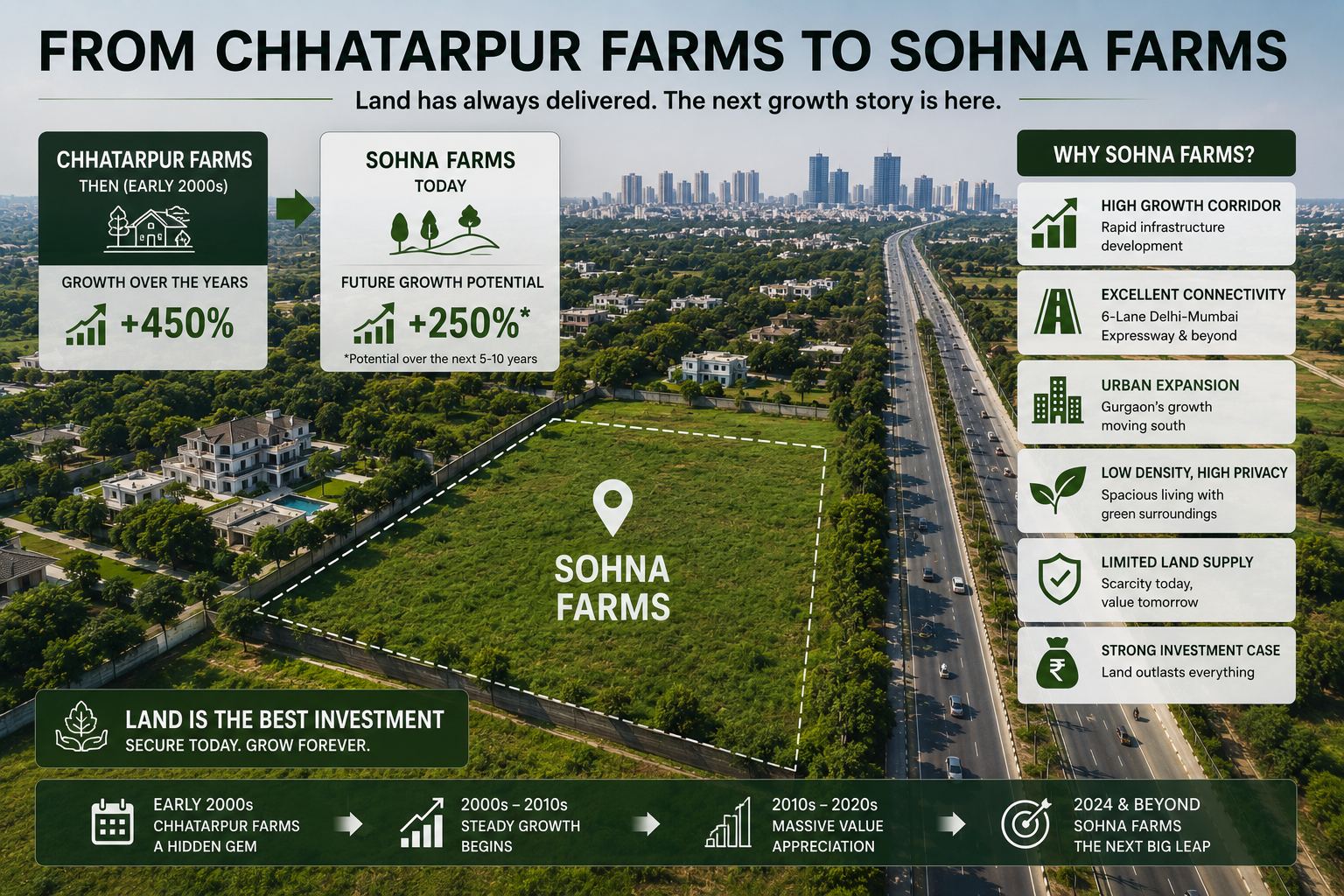
How Chhatarpur Farmhouses Created Multi-Crore Wealth for Early Buyers
What a quiet corner of South Delhi can teach investors about land, scarcity, and long-term wealth creation.

The ₹5 Crore Land Purchase That Became Worth ₹70 Crore
What the Story of DLF Chhatarpur Farms Reveals About Wealth Creation Through Premium Land Ownership
One short email. Stories you can use.
A free, occasional email from our editorial team with our latest features, explainers and reads. Unsubscribe any time — your email stays with us.