Why Perfumes Cost More and Smell Less: The Reformulation Problem
Shrinking access to raw materials, tightening international safety regulation and the economics of luxury branding are quietly rewriting the fragrances you thought you knew.
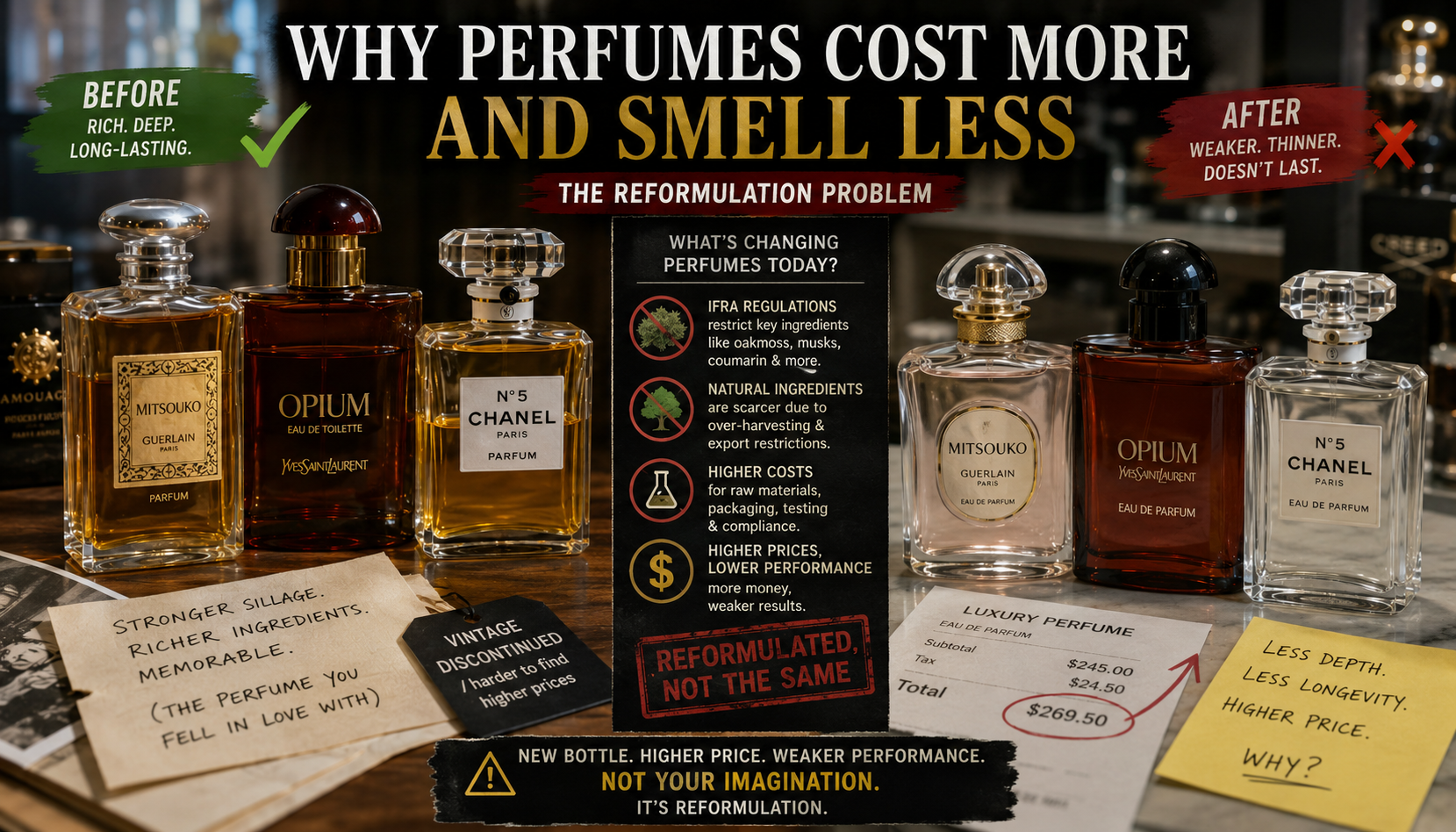
Anyone who has worn the same "signature scent" for a decade has probably noticed it. The bottle looks identical. The price is often higher than last year. But the fragrance itself feels thinner, fades faster, and lacks the depth of the version you fell in love with. This isn't nostalgia or a placebo effect. It's the result of three forces colliding: shrinking access to raw materials, tightening international safety regulation, and the economics of luxury branding. Here's what's actually going on.
Regulation is the biggest, least-talked-about factor
The fragrance industry is self-regulated through the International Fragrance Association (IFRA), which issues Standards restricting or banning ingredients based on dermatological and toxicological data (much of it compiled by RIFM, the Research Institute for Fragrance Materials). These Standards are then enforced across the industry because major raw-material suppliers (Givaudan, Firmenich/DSM, IFF, Symrise) simply stop selling non-compliant materials, and the EU Cosmetics Regulation (EC 1223/2009) backs this with legal teeth for allergen labeling and concentration limits.
Every few years IFRA issues a new "Amendment" that lowers the allowed percentage of a material, or removes it outright. Ingredients affected over the last two decades include:
Oakmoss (Evernia prunastri), restricted because natural extracts contain atranol and chloroatranol, potent skin sensitizers. This is the single biggest reason so many classic chypre and fougère perfumes (a whole family of fragrances built on oakmoss) smell different today.
Nitro-musks and later several polycyclic musks, some banned for environmental persistence and bioaccumulation, others capped in concentration. Musks are the "fixative" backbone of a fragrance; they're what makes a scent cling to skin and clothing for hours. Reducing them is a direct hit to longevity.
Coumarin and furanocoumarins (bergapten in cold-pressed bergamot), capped due to photosensitization and allergy risk.
Certain aldehydes and natural absolutes (jasmine absolute, rose absolute in some contexts), capped or requiring IFRA-certified substitutes.
None of this is a conspiracy. It's a genuine, documented tightening of safety thresholds. But the practical effect is that perfumers are repeatedly forced to rebuild formulas around materials that were never part of the original creative vision, and the replacements rarely behave identically in terms of diffusion (sillage) or longevity.
Raw materials are also getting scarcer and pricier, for reasons that have nothing to do with safety
Natural sandalwood (Mysore sandalwood especially) has been under Indian export restriction for years due to over-harvesting; what's available now is mostly from Australia and is a different, thinner-smelling material.
Oud/agarwood from Aquilaria trees is CITES-listed in several source countries. Genuine aged oud oil can cost several thousand dollars per kilogram, so most "oud" fragrances, including plenty of niche ones, now lean on synthetic oud accords or heavily diluted natural material blended with synthetics.
Ambergris is naturally sourced (whale-derived) and effectively unregulated in supply, meaning price and availability swing unpredictably, pushing brands toward synthetic ambroxan, which is cheaper but has a different, "cleaner" character than the real thing.
Post-2020 supply-chain disruption and inflation raised the cost of essential oils, packaging glass, and specialty solvents across the board, and those costs haven't fully reversed.
Meanwhile, retail prices keep climbing, because price and formula quality are not the same lever
This is the part that frustrates enthusiasts most: reformulation almost never comes with a price cut. Luxury and niche houses have other, non-ingredient cost pressures that push prices up regardless of what's in the juice: flagship boutique real estate, celebrity/brand-ambassador marketing, hand-finished bottles and packaging, compliance testing itself (safety testing and allergen disclosure is expensive), and the pursuit of higher margins as "niche" and "luxury" positioning became a growth strategy across the 2010s and 2020s. So you get the uncomfortable pattern: less oakmoss, less musk, less real oud, but a higher price tag.
Real-world before/after examples
Guerlain Mitsouko (1919), built on an oakmoss-and-peach-aldehyde chypre structure. Post-2010s IFRA-compliant reformulations are consistently described by perfumers and collectors as thinner and less mossy than 1980s to 90s bottles, which now sell at a premium on vintage markets specifically because of this.
YSL Opium (1977), the original was a dense, animalic oriental leaning heavily on oakmoss and balsamic resins. The 2009 and later reformulations, done to meet tightening IFRA rules, are noticeably softer and sweeter, with far less of the original's smoky depth.
Chanel No 5, reformulated multiple times since 1921, most recently to adjust aldehyde levels and musk composition. Extrait (pure parfum) concentration versions are still considered closer to the historic character than the Eau de Parfum, partly because the extrait uses a different, less-regulated blending ratio.
Creed Aventus, this one isn't primarily an IFRA story, but it's the case niche-fragrance communities cite most. Creed has openly discussed sourcing shifts in its base materials (birch and ambroxan-related components) between production runs, and "batch" became a whole sub-hobby: enthusiasts compare letter/number codes on the bottle bottom and pay resale premiums for specific older batches believed to perform better and smell "fruitier" or "smokier" than current stock.
Niche brands using real oud (Amouage, Xerjoff, Nishane, and others), many built early reputations on genuine agarwood oil. As that raw material's price and availability worsened, several quietly shifted toward synthetic oud accords in newer formulations or newer product lines, while keeping the same bottle design and, often, a higher price than the original.
So what's actually happening right now
The trend is continuing, not reversing. IFRA keeps issuing new Amendments as more toxicological data comes in, natural raw-material supply keeps tightening due to over-harvesting and climate pressure on specific growing regions, and luxury pricing keeps climbing to protect margins and brand positioning. The result is a fragrance market where the artistry is arguably getting harder, not easier: perfumers are being asked to recreate the emotional effect of banned or scarce materials using a shrinking, more heavily regulated palette, while brands are simultaneously under pressure to justify rising prices to consumers who can, increasingly, smell the difference.
If you want to verify a specific reformulation story or the latest IFRA Amendment number, it's worth checking IFRA's own published Standards (ifrafragrance.org) or fragrance-community sources like Fragrantica and Basenotes, since new Amendments are issued periodically and this is a moving target.
News Legacy maintains editorial independence. Some recommendations may contain affiliate links. We earn from qualifying purchases at no additional cost to you. Read our policy.
Read Next

Is Sohna Really the Next Chhatarpur?
Three decades after Chhatarpur redrew South Delhi's map for space, privacy and exclusivity, a familiar pattern is now taking shape further south, and Sohna is where the smart money is beginning to look.

How Chhatarpur Farmhouses Created Multi-Crore Wealth for Early Buyers
What a quiet corner of South Delhi can teach investors about land, scarcity, and long-term wealth creation.

The ₹5 Crore Land Purchase That Became Worth ₹70 Crore
What the Story of DLF Chhatarpur Farms Reveals About Wealth Creation Through Premium Land Ownership
One short email. Stories you can use.
A free, occasional email from our editorial team with our latest features, explainers and reads. Unsubscribe any time — your email stays with us.